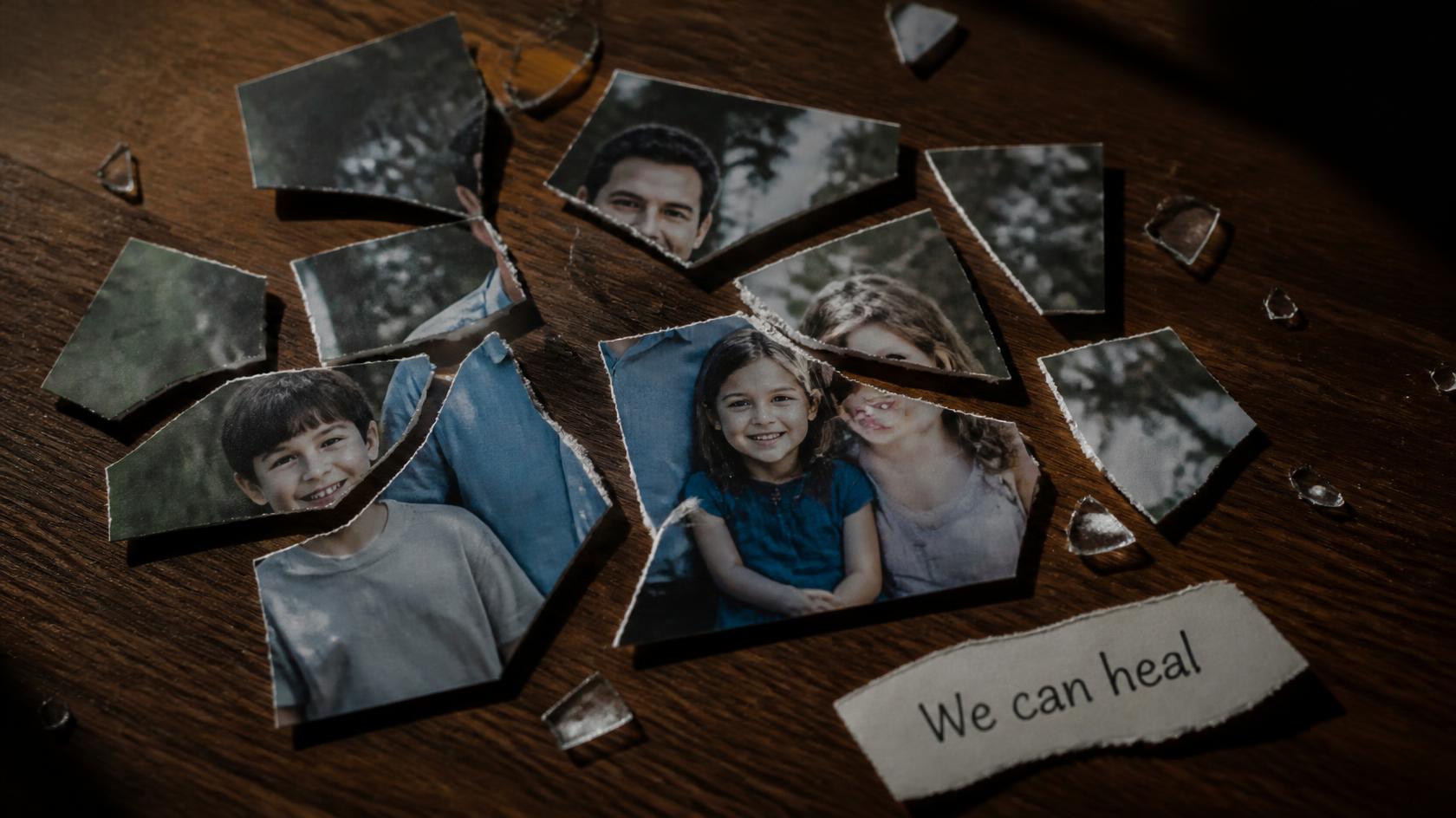
Ellen*, 62, has not spoken to her brother Daniel*, 58, in fifteen months. On the surface, the story is political. They fell out during the last election cycle, exchanged a series of texts that got progressively harder to walk back, and then simply stopped communicating altogether. Ellen assumed the silence was temporary. It has now outlasted two birthdays, a wedding, and the anniversary of their mother’s death.
She is beginning to understand that it was never really about the election.
If you recognize something in Ellen’s story, a family relationship that fractured along political lines and now feels stuck in a shape neither of you knows how to fix, you are not alone. The current cultural climate has produced a specific kind of family rupture that clinicians see with increasing frequency and that most people carry privately.
Political rupture is rarely only political.
When a family relationship falls apart along political or ideological lines, the visible fracture is almost always the last thing to break, not the first.
Underneath the specific policy disagreement, the vote for the “wrong” candidate, or the comment about the “wrong” movement, is usually a much older accumulation of uncomfortable feelings: who has felt seen inside this family and who has felt overlooked; whose worldview has been treated as “reasonable” and whose has been treated as an “aberration;” and whose version of the family story is even allowed to be true?
For Ellen and Daniel, the election was the accelerant. The tinder was thirty years of Ellen being the one their mother turned to and Daniel feeling quietly overlooked. When Daniel voted the way he did, part of what he was saying was: I am not the person you have always assumed I was. And part of what Ellen heard was: you never really knew me.
That is not a disagreement that can be resolved by proving one of them wrong about a political candidate.
The specific grief of political rupture.
There is a particular quality to political estrangement that makes it harder to metabolize than other kinds of family rupture.
There is no ritual for it. When a marriage ends, there is a legal process. When a parent dies, there is a funeral. When a friendship fades, there is at least an unspoken cultural script for it. Political rupture has none of these. The relationship is technically still available. The person has not moved away, they haven’t disappeared, they never asked for a “divorce.” They are still there. They are just not there in any way that matters.
Clinicians call this ambiguous loss. It is grief for someone who is still alive, still reachable, but no longer relationally accessible. It is one of the most difficult forms of loss to move through, because there is no closure to work toward and no defined thing to grieve. The person exists in the world. You simply no longer have access to them in the way you used to or would like.
There is also a cultural loss underneath the personal one. Most people who grew up in the last century assumed implicitly that families held together through political differences. Uncles and cousins voted differently. Thanksgiving got heated, and the issues were somehow resolved. That assumption is not holding for many families right now, and losing that assumption is its own grief on top of losing the relationship.
The which-side-broke-it trap.
The most common thing an estranged sibling or adult child will do with a political rupture is spend months, sometimes years, trying to determine whose fault it was.
The impulse is understandable. If you can locate the specific moment where the other person crossed a line, or the specific comment that started it, you have something concrete to hold. You have an explanation you can offer to friends. You have a version of the story that lets you sleep at night.
The clinical problem with that impulse is that it almost never produces movement. It produces rehearsal. You get very good at telling yourself the version of events that makes you the reasonable one, and the more you tell it, the less able you are to hear the version the other person is telling themselves.
For repair to become possible, both people have to be willing to hold the possibility that the rupture was mutual and structural, not the fault of a single moment or a single statement. That does not mean the political disagreement was not real. It means the political disagreement was the pressure that revealed a set of dynamics that were already fragile.
What to do with a relationship that is not dead but is not functional.
Not every family relationship that fractures politically is meant to be repaired to the way it was. Some need to be reshaped. Some need to end. Some need to sit quietly for longer than either person is comfortable with while both of you become people who could show up to a different conversation.
A few things are worth thinking about here.
Reconciliation is not the same as agreement. Reconciliation requires that both people can hold the other’s experience as real, even when they still disagree about the conclusions. It does not require anyone to change their vote, their worldview, or their values. Rather, it requires the capacity to say, “I can see how you got there, and I can be in relationship with you without needing you to be someone else.”
The door does not have to be closed permanently, and it does not have to be reopened tomorrow. In many political ruptures, the most sustainable move is a soft door, a quiet, low-stakes contact that does not attempt to relitigate the disagreement, offered without expectation of anything in return. A short message on a birthday. A photograph from a shared memory. Something that signals the relationship exists, without asking for anything.
The work is often internal before it is interpersonal. Trying to fix the relationship before you understand your own part in it usually accelerates the estrangement. Trying to fix the other person’s part in it before your own is worse. The work of therapy at this stage is not to script the reunion. It is to help you become someone who could be present to a different kind of conversation, so that if the door reopens, something has actually changed on your side of it.
A different way to hold the fracture.
Ellen has not reached out to Daniel. She may never. She has, however, stopped rehearsing the argument in her head every night before bed. She has started to hold the possibility that Daniel was, in his own way, telling her something true about how he had experienced the family for decades. She still doesn’t agree with his politics, but she has begun to see that his politics were not the point.
That shift is small, and it is everything. Estranged parents and siblings who eventually reconnect almost always describe some version of this story. There was a moment when they stopped needing to be right in order to be in relationship with one another and started being curious about what the other person had been carrying.
Political rupture inside a family is a real loss, and it deserves to be named as such. The grief is real, the confusion is real, and the impulse to figure out whose fault it was is totally understandable. It is also almost always a way of avoiding the harder question beneath: what has this relationship been asking of us for years that we have not been willing to hear?
If you are living inside a family rupture that started with politics and now seems to be about something else, and you are not sure where to begin, I can help you find a place to stand. Reach out to me directly at (702) 575-4723 to schedule an introductory call.
*Ellen and Daniel are fictional composite characters created for illustrative purposes. They do not represent any specific individual or client. The content of this post is strictly for educational purposes and is not a substitute for clinical or legal guidance.
